Key Takeaways
- Stethoscope hygiene is an overlooked part of infection prevention. Research shows the stethoscope diaphragm can carry bacterial contamination levels similar to clinicians’ hands, making it a potential vector for healthcare-associated infections (HAIs).
- Manual cleaning between patients is difficult to sustain in real clinical workflow. Time pressure, low compliance, and inconsistent cleaning effectiveness make traditional wipe-based stethoscope disinfection unreliable in busy healthcare environments.
- Workflow-based hygiene solutions improve compliance and patient safety. Technologies such as touch-free aseptic stethoscope barriers help ensure a clean diaphragm surface for each exam without disrupting clinical care.
The Stethoscope as the Clinician’s “Third Hand”
For patients, the consequences of healthcare-associated infections (HAIs) can be serious. HAIs can lead to longer hospital stays, additional treatments, and in some cases life-threatening complications. Patients who are already vulnerable, such as those in intensive care, oncology units, or post-surgical recovery, face even greater risk.
Because of these risks, infection prevention is an important, constant focus in healthcare. When people think about infection prevention in healthcare, they usually think about hand hygiene.
For good reason. Hands are the primary way pathogens move from one surface to another in clinical care.
But there is another surface that touches patients just as often.
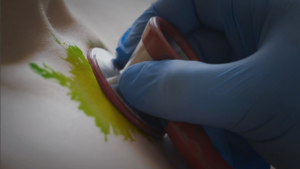
The stethoscope, particularly the diaphragm which intentionally comes into direct contact with patients.
It is used constantly during patient care. It comes into direct contact with skin. And it often moves from patient to patient throughout the day.
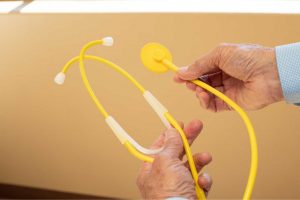
For these reasons, experts have referred to the stethoscope as the clinician’s third hand.
Yet it rarely receives the same attention as hand hygiene.
Research Shows Stethoscopes Frequently Carry Patient Pathogens
The idea of the stethoscope as a “third hand” is not just a metaphor. It is supported by research.
Didier Pittet, MD, MS, is an infectious disease expert, global leader in infection prevention, and key contributor to the 2002 CDC Guideline for Hand Hygiene in Health‑Care Settings which brought alcohol-based hand rub dispensers into standard of care.1 Pittet also helped advance research into how pathogens move during patient care through the stethoscope.
In his widely cited study, investigators measured bacteria on physicians’ hands and on their stethoscopes immediately after examining patients.2

They found that the stethoscope diaphragm had substantial contamination, second only to the fingertips. The contamination levels also correlated closely with contamination of the clinician’s hands.
In simple terms, the stethoscope behaves much like another hand during patient care.
It touches patients.
It picks up pathogens.
And it can carry them to the next patient.
Preventing infections requires attention to every point of patient contact, including the stethoscope diaphragm.
This is why infection prevention leaders increasingly emphasize that stethoscope hygiene deserves attention alongside hand hygiene. If the stethoscope functions as the clinician’s third hand, it should be treated with the same level of care.
Experts Are Bringing the Issue Back Into Focus
In recent months, the topic has resurfaced in professional discussions across infection prevention communities.
Experts speaking in Infection Control Today have highlighted the persistent gap in stethoscope hygiene and the need for practical solutions that fit into clinical workflow.
The conversation reflects something many clinicians already recognize.
The challenge is not awareness.
The challenge is making the right action easy to perform every time.
Why Stethoscope Cleaning Between Patients Is Difficult in Clinical Practice
We have already discussed why disposable stethoscopes are not a great solution to this longstanding issue in a previous article.
So let us address the elephant in the room: Why don’t we just have everyone clean their stethoscope between every patient?
On paper, the solution may appear simple. In reality, this approach faces several challenges.
Time pressure. Clinicians move quickly between patients, often in high‑acuity environments. Even short cleaning steps can be difficult to perform consistently during a busy shift. When guidance requires up to a minute of cleaning for maximum (yet still incomplete) efficacy, and at least two minutes of dwell time for the disinfectant to do its job, it raises a practical question: where does that time come from during routine patient care?
Workflow interruptions. Many cleaning methods require locating wipes or disinfectants, applying them correctly, and waiting for proper contact time. These extra steps can interrupt the flow of patient care.
Limited effectiveness. Studies have also shown that common cleaning practices do not always fully remove contamination from the diaphragm surface. In one study, observations on CDC-recommended cleaning (60 seconds of wiping) revealed only a 50% return to clean rate. This was reduced to 10% when “clinician-preferred” cleaning methods were observed.3
For this reason, simply telling clinicians to clean it more has not solved the problem.
Lessons from Hand Hygiene and IV Connector Infection Prevention
Soap and Water Alone for Hand Hygiene:
Just two decades ago, hand hygiene compliance struggled for similar reasons.
The turning point came when infection prevention experts shifted the focus from reminders to system design.
Thanks to those 2002 CDC Hand Hygiene Guidelines co-authored by Professor Pittett, alcohol-based hand rub dispensers placed directly at the point of care made the correct action easier to perform.
Today, these dispensers are an integral part of standard of care for hand hygiene in healthcare facilities across the nation.
The Problem with “Scrub the Hub”:
For years, clinicians were taught to disinfect the IV connector by “scrubbing the hub” with an alcohol wipe for up to 30 seconds before every access. This was meant to prevent contamination that can lead to central line–associated bloodstream infections (CLABSIs).
In reality, compliance was poor. Studies and hospital observations found that clinicians often skipped the step or did it too quickly because of workflow pressure.
Passive disinfecting caps, placed on IV poles for ease-of-access, greatly improved compliance by addressing human factors, workflow, and compliance visibility.
For hand and IV connector hygiene, compliance improved because the workflow improved. In healthcare, safety practices work best when they are built directly into the care process.
It required identifying what was not working, understanding why it failed in real clinical workflows, and putting a solution in place that clinicians would actually use.
In other words, a break from the status quo. Just as hand hygiene and IV connector hygiene improved through evidence-based innovation, stethoscope hygiene should follow the same path. The data is clear. Cleaning alone is not enough. What is needed is a standardized solution that fits naturally into clinical workflow.
A New Approach to Stethoscope Hygiene: Touch-Free Aseptic Stethoscope Barriers
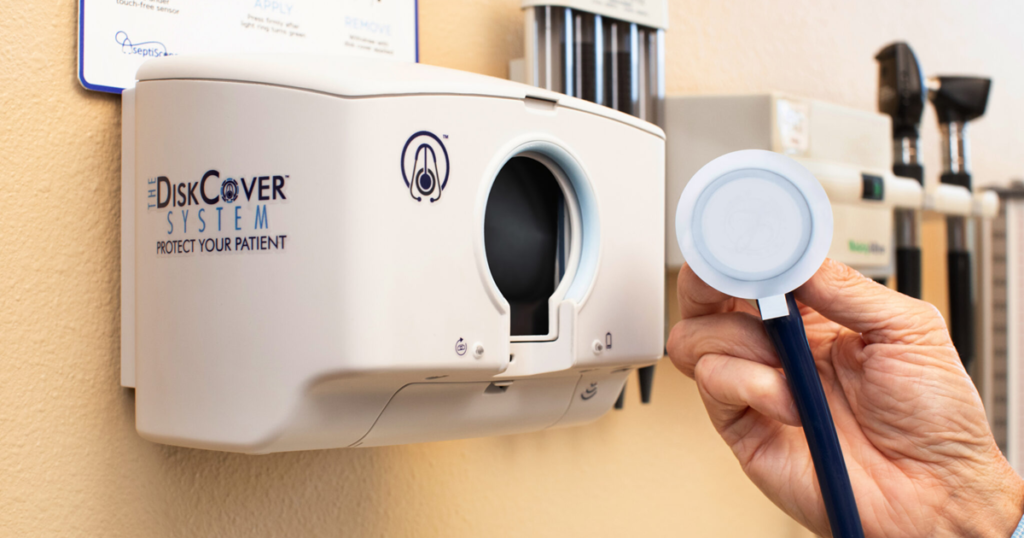
The DiskCover® System is evidence-based and addresses both compliance and efficacy challenges, by providing a touch-free, aseptic barrier for the stethoscope diaphragm before each exam.4
Instead of requiring clinicians to stop and manually clean the device, the system automatically applies a new aseptic disk cover at the point of care. This allows clinicians to use their own high-quality stethoscope while ensuring a clean patient contact surface during every exam.
Because the process takes only a moment and fits naturally into clinical workflow, it helps reduce the reliance on manual cleaning and supports more consistent stethoscope hygiene.
Improving Patient Safety by Addressing Stethoscope Hygiene
The stethoscope will remain a central tool in medicine. It is trusted by clinicians and recognized by patients around the world.
But as research continues to show, it should also be recognized for what it is during patient care.
A third hand.
And just like the other two hands clinicians use every day, it deserves a hygiene approach that fits naturally into clinical workflow.
Because in infection prevention, the safest systems are the ones that make the right action easy to perform every time.
References
- Boyce JM, Pittet D; Healthcare Infection Control Practices Advisory Committee; HICPAC/SHEA/APIC/IDSA Hand Hygiene Task Force. Guideline for Hand Hygiene in Health-Care Settings. Recommendations of the Healthcare Infection Control Practices Advisory Committee and the HICPAC/SHEA/APIC/IDSA Hand Hygiene Task Force. Society for Healthcare Epidemiology of America/Association for Professionals in Infection Control/Infectious Diseases Society of America. MMWR Recomm Rep. 2002;51(RR-16):1-CE4.
- Longtin Y, Schneider A, Tschopp C, et al. Contamination of stethoscopes and physicians’ hands after a physical examination. Mayo Clin Proc. 2014;89(3):291-299. doi:10.1016/j.mayocp.2013.11.016
- Knecht VR, McGinniss JE, Shankar HM, et al. Molecular analysis of bacterial contamination on stethoscopes in an intensive care unit. Infect Control Hosp Epidemiol. 2019;40(2):171-177. doi:10.1017/ice.2018.319
- Vasudevan R, Shin JH, Chopyk J, et al. Aseptic Barriers Allow a Clean Contact for Contaminated Stethoscope Diaphragms. Mayo Clin Proc Innov Qual Outcomes. 2020;4(1):21-30. Published 2020 Feb 5. doi:10.1016/j.mayocpiqo.2019.10.010