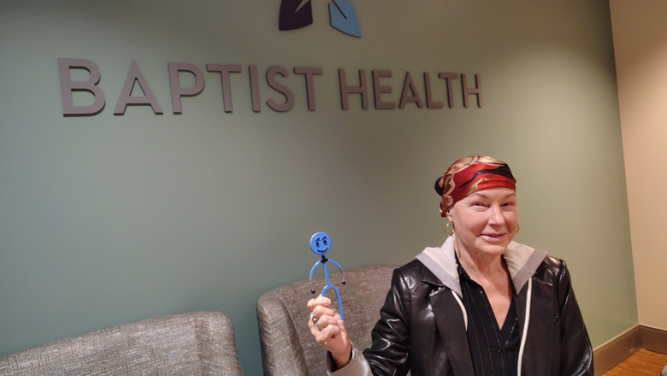
Cancer patient Pamela Lessenberry shares why consistent stethoscope hygiene matters for immunocompromised patients and how visible infection prevention builds trust.
Key Takeaways
- Cancer patients are immunocompromised and routinely asked to take strict precautions to avoid infection during treatment.
- Stethoscopes can carry contamination levels similar to clinicians’ hands when between-patient hygiene is not performed.
- Inconsistent device hygiene creates a gap between infection prevention guidance and real-world practice.
- Patients notice these gaps, especially when their own risk is clearly communicated.
- Workflow-compatible solutions can help ensure every patient encounter starts with a clean device.
The Reality of Infection Risk During Cancer Treatment
When you’re going through cancer treatment, infection prevention becomes part of your daily life.
Your care team is very clear: your immune system is compromised. You’re told to be careful with visitors, avoid close contact, and take every precaution to reduce risk.
You totally listen and want to do anything you can to keep that infection from happening.
And after you’ve been conditioned to treat your daily interactions as potential sources of life-threatening infections, you notice the things your care team is too. Hands are washed. Gloves are worn. Protocols are followed.
But it raises a simple question from the patient perspective:
Why do they tell me to do all these things if they are planning on examining me with a filthy stethoscope?
The Stethoscope Hygiene Gap: What Patients See
The stethoscope is used constantly throughout cancer care. During chemotherapy, during routine checks, during post-surgical recovery.
From a patient’s perspective, it’s one of the most frequent points of contact.
And yet, it’s also one of the least visibly addressed.
Stethoscopes can carry contamination levels comparable to clinicians’ hands when not disinfected between patients.
As patients, we notice patterns.
We see hands being cleaned over and over again.
I must have seen my care providers wash their hands a million times… but oddly, never the stethoscope.
I now know that the stethoscope and the hands carry the same micro-organisms, and why not? They are both touching me all the time.
That disconnect is hard to ignore, especially when you’ve been told how serious infection risk is.
Disposable Single-Patient Stethoscopes and “The Red Devil”
During my treatment, I was prescribed one of the most common (and as I’m told, effective) breast cancer treatments: doxorubicin, AKA “The Red Devil.”
One day this drug will be replaced by something more specific.
Until that time, we are getting it a lot, as it has real benefits.
It’s effective. It saves lives. But it also comes with real risks. It’s called The Red Devil for a few reasons:
- It is a bright red IV drug.
- It turns your urine red for a few days.
- It doesn’t just destroy the cancer, it can cause significant heart damage.
Because of that, monitoring matters. Stethoscopes are used frequently to assess heart function.
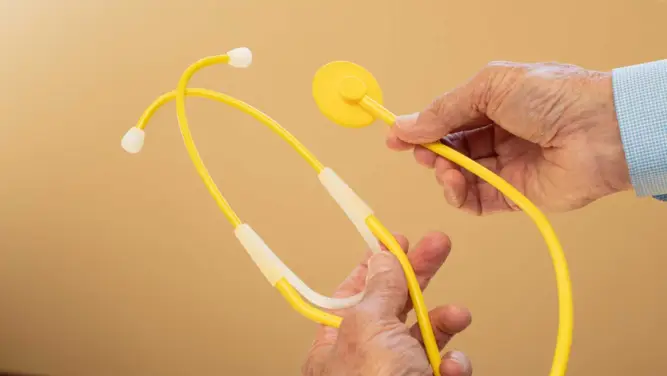
So when a clinician walks in with what looks like a low-quality disposable stethoscope, it raises concerns.
I’m told these disposable stethoscopes are meant to keep me safe from infection.
I asked about why they were not being cleaned, and they said that “this is a disposable stethoscope, so it is only going to touch you”.
I worked in healthcare. My dad was an internist, and he treasured his Littman stethoscope. He took pride in using it too.
This disposable stethoscope looked like it came from a box of Cracker Jacks.
Are they going to catch my heart murmur from the Red Devil with that thing?
Also, they are not sanitary. That thing was hanging on the wall when I came in, and it was hanging on the wall when I walked out. Nobody cleaned it once. It turns out, my temperature was elevated, and they halted my treatment early out of an abundance of caution.
After Surgery: When “Close Enough” Doesn’t Feel Safe
This is me outside the hospital. I’m a Pilates instructor, and hope to get back to normal someday.

But getting there isn’t simple. Following chemotherapy, I underwent a double mastectomy.
Now the concern shifts. Open incisions replace immunosuppression as the primary infection risk.
A nurse reassures you: “I won’t place the stethoscope directly on your incision.”
But from a patient’s perspective, that logic doesn’t quite hold.
Does that really work? I mean, if you lay a resistant pathogen just above or just below my scar, but not directly on it, I’m safe?
We know microorganisms can survive on surfaces for extended periods.
I remember microbiology, and those microbes seem very healthy for hours, days, even weeks.
We know indirect contact still matters.
Imagine if they tried to use that as justification for not washing their hands!
So, how is it that you don’t need to clean your stethoscope just because you’re not directly pushing it into my scar?
The Workflow Gap in Stethoscope Disinfection
Infection prevention guidelines recommend cleaning stethoscopes between patients.
But in real clinical environments, compliance can be inconsistent.
Not because clinicians don’t care, but because workflows are demanding.
When an intervention depends on time, memory, and extra steps, it becomes difficult to sustain.
This is where patients feel the gap most clearly.
They are asked to follow strict, consistent rules.
But the systems around them don’t always support that same level of consistency.
Emerging Solutions: Making Hygiene Visible and Consistent
Some healthcare organizations are beginning to address this gap by focusing on workflow-compatible solutions.
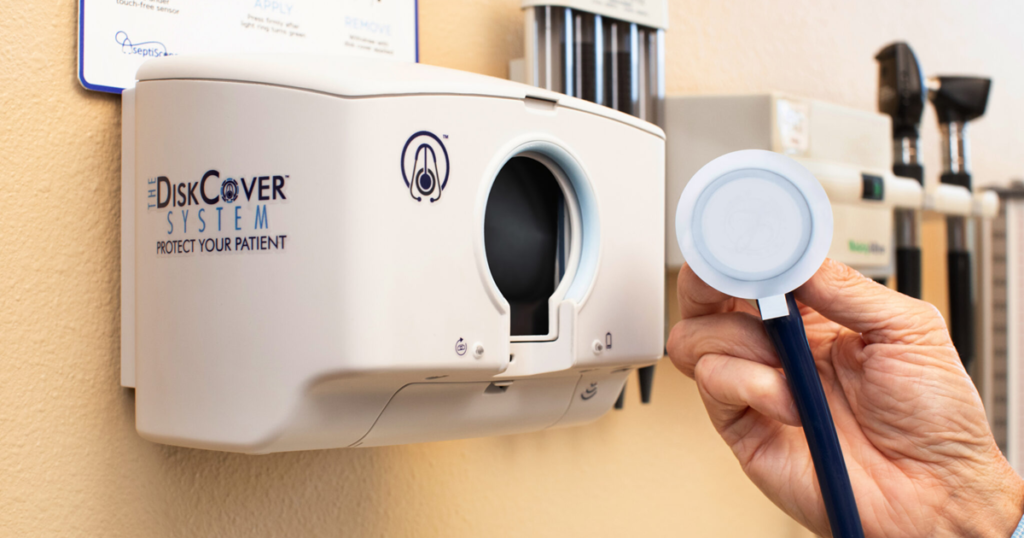
Instead of relying solely on manual disinfection, these approaches aim to ensure a clean patient-contact surface every time, without adding complexity.
One example is touch-free aseptic stethoscope barrier systems, such as The DiskCover System, which apply a new barrier before each exam.
From a patient’s perspective, visibility and consistency are important.
Patients want to know that the same level of care applied to hand hygiene is also applied to every device that touches them.
I recovered from the sepsis event, but the question of where it came from has never been fully resolved.
Patient Safety Means Every Detail Matters
I am thankful for my care providers. I also know that they do not have an easy job.
But really, I’ve been through the ringer here, and I don’t need to be taken down after beating cancer just because you can’t protect me from your stethoscope. I mean, REALLY?!
Patients are doing everything they can to get through it safely.
They are constantly reminded just how high those infection risks are, and how even small exposures can have serious consequences.
They follow the rules. They accept the risks. They trust their care teams.
But that trust depends on consistency.
Small gaps, like inconsistent stethoscope hygiene, stand out more when everything else is so tightly controlled.
From a patient’s perspective, the message is simple:
I’ll do my part. You do yours.