By Daniel J. Hannula
In our article, “Third-Hand Hygiene,” in the American Association for Justice’s Trial® magazine, my co-authors, quality and patient safety expert Cynthia Cadwell and Baylor College of Medicine researcher Dr. W.F. Peacock, and I argue that the lack of stethoscope hygiene policy in the US may fulfill standard criteria for medical negligence.
The healthcare industry has spent decades pursuing one overarching goal: reducing preventable patient harm. From hand hygiene campaigns and central line infection bundles to environmental cleaning initiatives and antimicrobial stewardship programs, hospitals have invested enormous resources to address healthcare-associated infections (HAIs). Yet one familiar medical device has largely escaped the scrutiny applied to other infection transmission risks: the stethoscope.
If healthcare policy requires hand hygiene between patients, should similar expectations apply to the most used medical device, which carries identical pathogens as hands? That question brings stethoscope hygiene into the realm of accountability, standard of care, and patient safety.
The Stethoscope as the “Third Hand”
The stethoscope is often characterized as a clinician’s “third hand.”
For decades, hand hygiene has been recognized as one of the most important interventions in preventing healthcare-associated infections. Hospitals invest heavily in hand sanitizer stations, compliance monitoring, education campaigns, and auditing programs because contaminated hands are a well-understood vector for pathogen transmission.
“You can superimpose the contaminants, pathogens, and even superbugs from stethoscopes and hands, and they are essentially identical”, says Frank Peacock, a leading authority in this category. “This strong correlation is no surprise to clinicians who rely on stethoscopes in evaluations constantly. Despite the consistent and growing data regarding this glaring patient safety issue, infection prevention in hospitals is devoid of stethoscope hygiene policy”, states Peacock.
A Legal Lens on a Clinical Problem
Stethoscope contamination can be examined through the traditional elements of a malpractice claim: duty, breach, causation, and damages.
Hospitals and healthcare providers have a duty to protect patients from foreseeable infection risks. If contaminated stethoscopes are known to harbor pathogens and potentially contribute to infection transmission, failing to address that risk could potentially constitute a breach of that duty. Should a patient subsequently suffer a serious infection, questions regarding causation and damages may follow.
The legal considerations surrounding stethoscope hygiene have appeared in medical and legal literature before. An online search now reveals both medical research and law firms offering advice to patients who acquired infections while seeking care. The published Trial article brings this issue to a national legal audience.
Historically, many patient safety issues have gained momentum when legal, regulatory, and clinical perspectives began to align. Hand hygiene, surgical time-outs, medication safety systems, and central line infection prevention efforts all evolved through a combination of scientific evidence, policy guidance, and accountability mechanisms.
Stethoscope hygiene may be approaching a similar inflection point.
THE IMPACT OF EFFECTIVE STETHOSCOPE HYGIENE: THE MEMPHIS VA EXPERIENCE
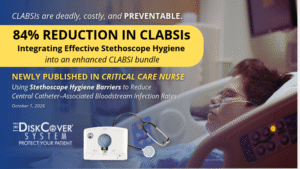
At the Memphis Veterans Affairs Medical Center, infection prevention leaders observed a rise in central line-associated bloodstream infections (CLABSIs) following the COVID-19 pandemic. The team noticed that stethoscopes were not being disinfected as clinicians assessed patients near the central line entrance. Their experience was presented at a 2025 critical care conference.
Following a literature search, the team incorporated touch-free dispensing systems for aseptic stethoscope barriers into its infection prevention bundle.
The reported results included a reduction in CLABSI events of approximately 84%, with infection rates reportedly declining from 3.13% in 2021 to zero by 2025.
While no single intervention can definitively claim sole responsibility for such outcomes, the drop and sustained absence of life-threatening infections are notable. Effective stethoscope hygiene was the component modified from the standard bundle, highlighting its potential contribution to reducing avoidable infections.
For patient safety and quality professionals, these findings warrant examining whether infection prevention policies adequately address contaminated stethoscopes.
NEW INFECTION PREVENTION STANDARDS TO ADVANCE PATIENT SAFETY
The Association of perioperative Registered Nurses (AORN) has long recommended that every patient receive a clean stethoscope examination every time. Updated CDC guidance, which has been voted on and published online in draft format, recommends hygiene between every patient encounter through disinfection and/or disposable aseptic barriers.
Cynthia Cadwell is an advanced practice nurse and quality and patient safety expert who has been practicing, publishing, and educating in this category for decades. “Healthcare Associated Infections are PREVENTABLE but actually eliminating them requires policy, procedures and compliance with best practices that evolve with evidence. The data on the stethoscope as a vector is indisputable, transmitting deadly pathogens the same our hands. Consequently, we have an obligation to protect our patients from this established safety challenge”, she states. Cadwell and a group of experts have developed an evidence-based policy and procedure template to help healthcare organizations integrate effective stethoscope hygiene.
Standards of care are not static. They evolve alongside emerging science, professional guidelines, and accepted practices. Attorneys evaluating future infection cases will inevitably look at what was known at the time an event occurred and whether reasonable precautions were available.
Awareness of stethoscope contamination is growing while practical solutions are becoming increasingly available. That combination has historically altered healthcare expectations.
The Challenge of Causation
Critics of stethoscope-related liability arguments often note that healthcare-associated infections are complex and multifactorial. Determining precisely how a pathogen reached a patient can be extraordinarily difficult.
The Montana Supreme Court case Beehler v. Eastern Radiological Associates provides a useful framework for considering this challenge.
In that case, expert testimony was allowed regarding how a physician’s failure to wear a mask during a procedure may have contributed to a patient developing bacterial meningitis. The court did not require absolute certainty regarding the source of transmission. Instead, it permitted testimony based on experience, available evidence, and a differential assessment of the most likely cause. In a medical malpractice case, the plaintiff’s burden of proof on causation is “more probably or more likely than not,” rather than scientific certainty.
As a liability attorney, I have represented plaintiffs who have suffered due to medical negligence for decades. When patients seek care at their most vulnerable, providers have a responsibility to protect their safety. Hand hygiene policies and compliance records document how providers address a known infection risk. The evidence and evolving guidance regarding stethoscopes similarly call for a policy addressing this heavily contaminated “third hand.”
With medical data confirmed in the cited literature regarding contaminated stethoscopes, courts under the long-established rules to prove medical causation should allow a case of injury or death allegedly caused by contaminated stethoscope to proceed to trial.
The Significance Beyond Litigation
Patient safety evolves continuously. Risks that once received little attention are increasingly subjected to scientific evaluation and public scrutiny. As healthcare organizations pursue zero harm initiatives, the evidence supports including stethoscope hygiene. The evidence further characterizes a strong financial return on investment when effective stethoscope hygiene is integrated into policy and care bundles.
Contaminated stethoscopes are not responsible for every healthcare-associated infection, and infection prevention cannot be reduced to a single intervention.
The fundamental question remains: if a recognized patient-contact device can harbor dangerous pathogens and practical solutions exist to reduce that risk, what responsibility do healthcare organizations have to act?
For infection prevention leaders, risk managers, hospital executives, and clinicians, the stethoscope deserves the same patient safety scrutiny applied to other potential sources of preventable harm.
This discussion belongs across clinical, quality, risk management, and executive leadership teams.